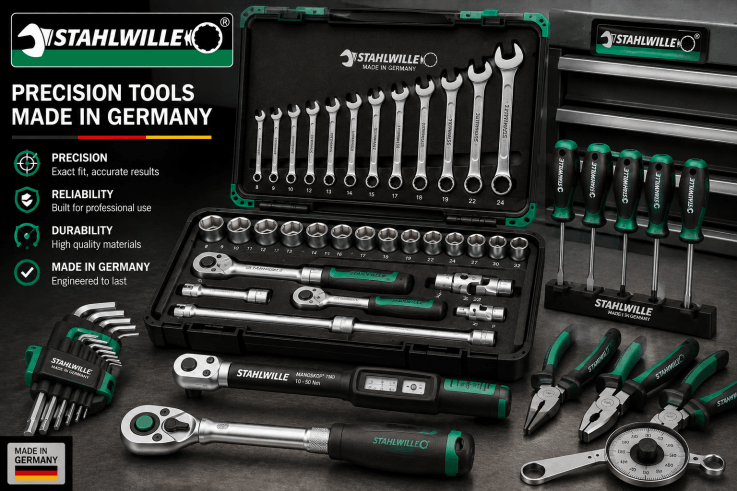
Stahlwille Tools: Precision Hand Tools for Professional Workshop and Engineering Work
For professional mechanics, engineers and maintenance technicians, the quality of a hand tool can have a direct impact on accuracy, efficiency and safety. Tools used in demanding environments must withstand repeated loads while providing a precise fit on fasteners and components. This becomes particularly important when working on vehicles, machinery or engineered assemblies where damaged fasteners or incorrect tightening can create much larger problems.
For professionals researching Stahlwille Tools, the range is particularly associated with precision hand tools, socket systems, spanners, torque equipment and specialist workshop products. These types of tools are commonly required in automotive, engineering, industrial maintenance and other technical environments where accuracy and dependable performance are important considerations.
Socket sets form the foundation of many professional tool collections. A correctly sized socket surrounds the fastener securely, allowing torque to be applied more evenly than would be possible with improvised alternatives. This reduces the likelihood of damaging nuts and bolts while making repetitive assembly and maintenance work more efficient.
Different drive sizes allow sockets to be matched to the application. Smaller drives provide compact access for lighter work, while larger systems are designed to accommodate higher loads. Professional technicians will often maintain several socket systems so they can choose equipment according to the fastener, available space and torque requirements.
Ratchets are equally important. In restricted spaces, the amount of movement required before the mechanism engages can determine whether a tool can be used effectively. Fine-tooth ratchets require a smaller working arc, making them useful inside engine compartments, machinery and tightly packed mechanical assemblies.
Extensions and universal joints further increase the versatility of a socket set. A fastener may be recessed behind another component or positioned at an awkward angle, and appropriate accessories can often provide access without requiring unnecessary dismantling.
Spanners remain essential despite the convenience of sockets. Combination spanners generally provide an open end alongside a ring end, allowing technicians to select the most appropriate approach depending on access. A precise fit is particularly important because poorly fitting tools can round fasteners when significant force is applied.
Ratcheting spanners can make repetitive work considerably faster. Their internal mechanism allows the fastener to be turned without repeatedly removing and repositioning the tool. This is particularly valuable in areas where there is insufficient room for a conventional full rotation.
Torque equipment is one of the areas where precision becomes especially important. Many automotive and engineering components have manufacturer-specified tightening values. Applying too little torque can allow a fastener to loosen, while excessive force may damage threads, distort components or compromise the assembly.
A torque wrench allows controlled tightening to a predetermined value. Selecting the correct torque range is essential because one tool may not be suitable for everything from delicate components to heavily loaded wheel or suspension fasteners.
Professional torque tools should be treated as precision instruments rather than general-purpose ratchets. Correct storage, careful handling and calibration according to appropriate schedules help maintain their accuracy over time.
Electronic torque technology provides additional options for applications requiring detailed control or repeatable measurements. Depending on the equipment, digital displays, audible signals or other indicators can help technicians identify when the required torque has been reached.
Torque screwdrivers perform a similar role at much lower torque values. They can be valuable in electronics, precision engineering and other applications where small fasteners need to be tightened consistently without applying excessive force.
Screwdrivers remain fundamental workshop tools. Modern vehicles and equipment use numerous fastener profiles, including slotted, Phillips, Pozidriv, Torx and hex designs. Matching the driver precisely to the fastener helps achieve better engagement and reduces the possibility of damaging the screw head.
Pliers and cutters provide another essential group of tools. Combination pliers offer general-purpose gripping and cutting, while long-nose versions allow access to confined areas. Circlip pliers, side cutters and specialist gripping tools are designed for more specific applications.
Breaker bars are useful when dealing with stubborn fasteners. Their longer handles provide additional leverage while avoiding unnecessary stress on a ratchet mechanism. Once the fastener has been loosened, a conventional ratchet can normally be used to complete the removal efficiently.
Tool dimensions and weight can also influence usability. A compact tool can provide better access, while reducing unnecessary weight can make equipment more comfortable during extended use. These considerations become increasingly important for technicians who use hand tools continuously throughout the working day.
Workshop organisation should not be overlooked. As a professional collection grows, locating individual tools can become time-consuming unless equipment is stored logically. Cabinets, drawer systems, cases and fitted modules help create an organised working environment.
Fitted tool trays can be particularly useful because each piece of equipment has a designated location. A missing socket, screwdriver or spanner becomes immediately noticeable, helping ensure tools are returned after each job.
This can have safety benefits as well as organisational advantages. In automotive, aerospace and engineering environments, ensuring no equipment has accidentally been left inside machinery or assemblies can be extremely important.
Specialist tools become more valuable as work becomes increasingly technical. General hand tools may cover routine maintenance, but particular mechanical systems often require dedicated equipment to remove, install or adjust components correctly.
Using purpose-designed tools can reduce the temptation to improvise. Improvised techniques may damage expensive components, create safety risks or significantly increase the amount of time required to complete a repair.
Tool maintenance remains important regardless of manufacturing quality. Equipment should be cleaned after exposure to grease, dirt, chemicals or moisture and stored somewhere dry. Moving mechanisms should also be inspected periodically for wear or damage.
Sockets and spanners deserve regular inspection because damaged drive areas or worn jaws can affect their grip on fasteners. Tools showing cracks, deformation or significant wear should be removed from service rather than continuing to be used under heavy loads.
Selecting appropriate tools also means understanding the difference between conventional and impact equipment. Standard sockets should not automatically be used with powered impact wrenches. Impact-rated sockets are specifically designed to withstand the repeated forces generated by these machines.
For professional users, building a toolkit gradually can be more practical than purchasing a huge collection immediately. Starting with commonly used sockets, spanners, ratchets, screwdrivers and pliers creates a useful foundation.
Precision torque equipment and specialist tools can then be added according to actual requirements. A general automotive technician, industrial engineer and aerospace mechanic may all require very different specialist equipment despite sharing many basic hand tools.
Long-term value should also be considered. A tool used repeatedly every working day may justify greater investment than equipment required only occasionally. Durability, precision, ergonomics and replacement availability can therefore be more relevant than purchase price alone.
Ultimately, Stahlwille Tools are associated with the type of precision hand and torque equipment required across professional automotive, engineering and industrial environments. By selecting accurate sockets, spanners, ratchets and torque tools, maintaining them correctly and organising equipment effectively, professionals can build a workshop toolkit capable of supporting precise, efficient and dependable work over the long term.